Artificial Intelligence is rapidly changing financial services. From fraud detection and customer service to lending, compliance, and operational efficiency, organizations are finding new ways to incorporate AI into everyday business activities. The opportunities are significant, but so are the governance responsibilities.
Throughout my career, I have learned that organizations rarely struggle because they embrace innovation. More often, they struggle because governance fails to evolve alongside it.
That observation inspired this writing series focused on Enterprise Risk, Governance, and Compliance. Rather than discussing technology for technology's sake, these articles explore how organizations can adopt emerging capabilities responsibly while maintaining sound governance, regulatory compliance, and operational resilience.
This summer series begins with a practical question every financial institution should be asking:
How do we govern Artificial Intelligence before it governs us?
AI Governance Is a Business Responsibility
Much of today's AI conversation focuses on what the technology can accomplish. Organizations are evaluating automation, predictive analytics, generative AI, and intelligent decision-making to improve efficiency and enhance customer experiences.
Those conversations are important, but they often overlook a more fundamental question.
Who is responsible for governing AI?
The answer is not Information Technology alone.
Artificial Intelligence affects nearly every part of an organization. Compliance interprets regulatory expectations. Risk Management evaluates enterprise risk. Legal advises on legal implications. Information Security protects data. Business leaders determine how AI supports strategic objectives. Internal Audit provides independent assurance. Executive leadership establishes expectations, and the Board provides oversight.
AI governance succeeds when these functions work together.
Organizations should resist creating AI governance in isolation. Instead, AI should become part of existing Enterprise Risk Management and Compliance Management Systems. Doing so allows institutions to leverage governance structures they already trust while adapting them to emerging technologies.
Innovation moves quickly. Governance must move with it.
A Practical AI Governance Framework
One of the questions I hear most often is, "Where do we start?"
The answer is usually simpler than organizations expect.
Most institutions already possess many of the building blocks necessary for effective AI governance. The objective is not to create an entirely new governance program, but to integrate AI into existing governance processes.
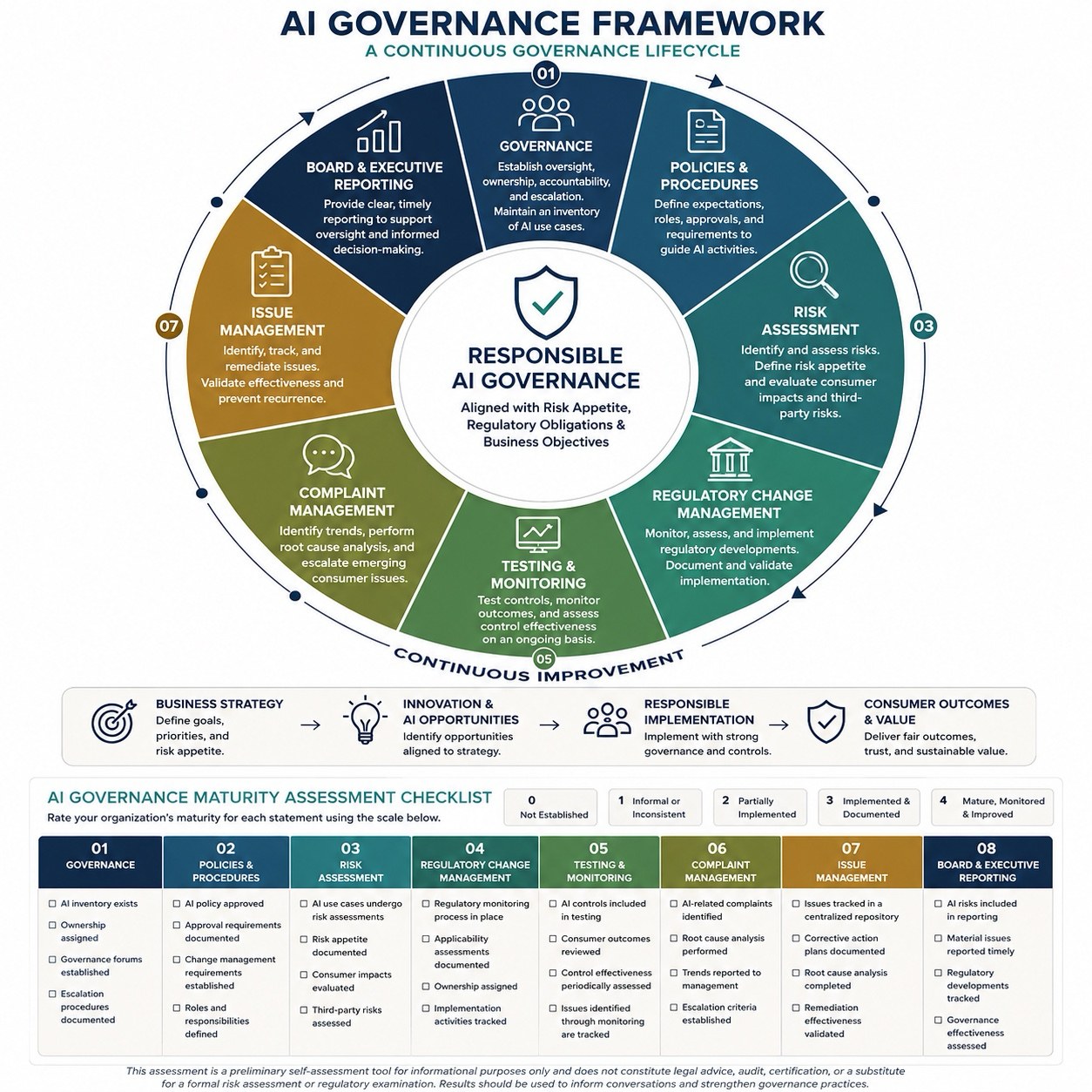
The framework illustrates AI governance as a continuous lifecycle rather than a series of independent activities. Governance establishes accountability. Policies and procedures define expectations. Risk assessments identify potential exposures. Regulatory change management monitors evolving requirements. Testing and monitoring validate controls. Complaint management provides early warning indicators. Issue management drives corrective action. Board reporting supports oversight and informed decision-making.
Each component reinforces the others.
When one area weakens, the effectiveness of the overall governance program begins to erode.
Five Principles of Effective AI Governance
Although every organization approaches governance differently, five principles consistently distinguish mature AI governance programs.
Treat AI as an enterprise initiative. AI is not simply another technology project. Decisions made by AI can affect customers, employees, operations, and regulatory compliance. Governance should reflect that enterprise-wide impact.
Define accountability early. Successful organizations establish clear ownership before AI initiatives mature. Governance committees, executive sponsors, and defined escalation paths reduce uncertainty and strengthen decision-making.
Integrate governance into existing processes. Rather than creating parallel governance structures, organizations should incorporate AI into established risk assessments, policy governance, testing programs, issue management, and executive reporting. This approach creates consistency while reducing unnecessary complexity.
Monitor continuously. AI governance does not end at implementation. Models evolve, regulations change, and business strategies shift. Continuous monitoring helps organizations identify emerging risks before they become larger problems.
Enable innovation through governance. Governance should not be viewed as an obstacle to innovation. Effective governance provides the confidence to adopt new technologies responsibly while protecting customers, maintaining regulatory compliance, and supporting sustainable growth.
Final Thoughts
Artificial Intelligence will continue transforming financial services for years to come.
The organizations that succeed will not necessarily be those implementing AI the fastest. They will be the organizations that establish governance capable of evolving alongside innovation.
Responsible AI begins with responsible leadership.
Technology may accelerate decisions, but governance remains a human responsibility.
As compliance and risk professionals, we have an opportunity to help our organizations embrace innovation while preserving the principles that have always mattered: accountability, transparency, sound risk management, and trust.
Those principles will continue to define successful organizations long after today's technologies have evolved.
Ready to Take the Next Step?
Implementing AI governance doesn't require starting from scratch, but it does require a structured approach.
If your organization is evaluating, implementing, or strengthening AI governance, I've developed two companion resources to help you get started. Whether you're a financial institution, fintech, or another organization exploring the responsible use of AI, these resources are designed to support meaningful conversations and practical action.
AI Governance White Paper
A comprehensive guide that expands on the AI Governance Framework with practical implementation guidance, governance considerations, and executive insights.
Download the White PaperExecutive AI Governance Maturity Assessment
A practical, eleven-domain assessment that helps executives, Chief Compliance Officers, Chief Risk Officers, and Boards evaluate current governance capabilities, identify gaps, and prioritize next steps.
Download the Assessment
Alison Stokes, CRCM
Alison Stokes, CRCM is a senior enterprise risk, governance, and compliance executive with 20+ years leading regulatory governance, examination readiness, fair lending oversight, and enterprise compliance modernization across banking, fintech-adjacent, and data-driven financial services environments.
alisonstokes.comReferences
- National Institute of Standards and Technology (NIST). Artificial Intelligence Risk Management Framework (AI RMF 1.0)
- National Institute of Standards and Technology (NIST). NIST AI Risk Management Framework (AI RMF) Playbook
- International Organization for Standardization / International Electrotechnical Commission. ISO/IEC 42001:2023, Information Technology, Artificial Intelligence, Management System
- Board of Governors of the Federal Reserve System. SR 11-7: Guidance on Model Risk Management
- Office of the Comptroller of the Currency (OCC). Heightened Standards for Certain Large Insured National Banks, Insured Federal Savings Associations, and Insured Federal Branches
- Consumer Financial Protection Bureau (CFPB). Circular 2022-03: Adverse Action Notification Requirements in Connection with Credit Decisions Based on Complex Algorithms
- Organisation for Economic Co-operation and Development (OECD). OECD AI Principles
- Federal Financial Institutions Examination Council (FFIEC). ffiec.gov